Loosely inspired by Dante's "The Divine Comedy"
by Romeo Castellucci
(associate artist)
/Socìetas Raffaello Sanzio
Cesena
Parc des Expositions - Avignon
Creation 2008
Running time mn
|
T 3 |
F 4 |
S 5 |
S 6 |
M 7 |
T 8 |
W 9 |
T 10 |
F 11 |
S 12 |
S 13 |
M 14 |
T 15 |
W 16 |
T 17 |
F 18 |
S 19 |
S 20 |
M 21 |
T 22 |
W 23 |
T 24 |
F 25 |
S 26 |
|
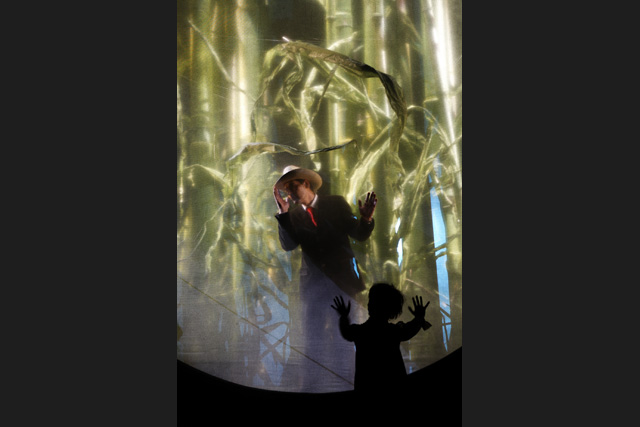
Purgatorio © Christophe Raynaud de Lage / Festival d'Avignon
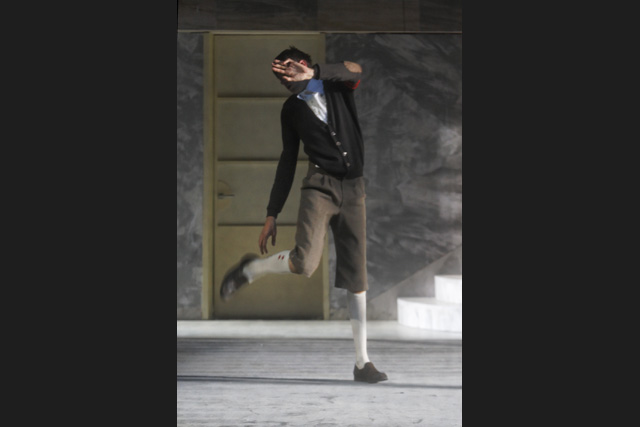
Purgatorio © Christophe Raynaud de Lage / Festival d'Avignon
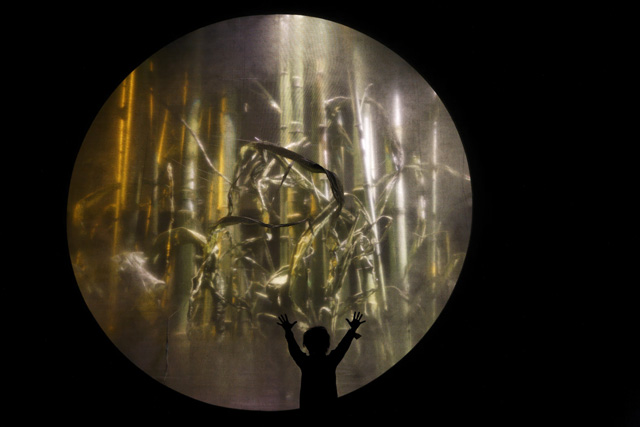
Purgatorio © Christophe Raynaud de Lage / Festival d'Avignon
Purgatorio © Christophe Raynaud de Lage / Festival d'Avignon
Purgatorio © Christophe Raynaud de Lage / Festival d'Avignon
Purgatorio © Christophe Raynaud de Lage / Festival d'Avignon
After studying plastic arts at the Beaux-Arts of Bologna, Romeo Castellucci founded in 1981 Socìetas Raffaello Sanzio, with his wife, the playwright Chiara Guidi, and his sister, the writer Claudia Castellucci. They moved to Cesena, into the Teatro Comandini, a former ironworks, a space favourable to stage experiments, in the Italian region of Emilia-Romagna. It is here that Romeo Castellucci developed an original stage art, bringing together all forms of artistic expression (theatre, music, painting, opera as well as mechanics and the production of images), aiming at reaching the spectator's senses. Stagecraft and its trades, like the new technologies and their most sophisticated manifestations, are mobilized in the minutely detailed conception of different shows, both very frontal and very elaborate. On each occasion, the matter is one of forging a “stage language” whose truth is revealed through an energy of bodies, through the vital and concrete presence of materials, movement, flesh, sound and visual elements, staged to produce meaning in the spectator's view. In his creations, he often works with children and also puts on shows for them like Hansel and Gretel or Buchettino (Tom Thumb). Since the mid-1990s, the Societas' shows have become increasingly well-known, especially Hamlet and The Vehement Exteriority of the Death of a Mollusc, Masoch and Orestea, an “organic comedy” based on the original Greek play. His shows sometimes divide the public, but compel recognition as an experience that remains imprinted in each spectator's sensorial memory. Romeo Castellucci accepts this contradictory perception and does not hesitate to meet the public. He engages in dialogue and likes to explain himself and the Festival d'Avignon has given him many occasions to do so. Romeo Castellucci presented his first show, Giulio Cesare (Julius Caesar) after Shakespeare at the Festival in 1998. He returned in 1999 with Journey to the End of Night by Céline, which was one of the premiere events of the Festival in the Cour du lycée Saint Joseph, then in 2000 with Genesi. In 2001, Romeo Castellucci and Socìetas Raffaello Sanzio launched the enormous cycle of Tragedia endogonidia, a performance system that, like a living organism, transforms itself in time and space depending on the path it takes from one premiere to another through European cities, leaving from Cesena to return there, by way of Berlin, Brussels, Bergen, Paris, Rome, Strasbourg, London, Marseille and Avignon. The theme common to the 11 episodes, spread out over four years and an entire continent, is a lyricism of suffering, from which a vital energy of bodies emerges that the spectator perceives through a certain violence, but also through the experience of the movements, rhythms, colours and sounds of our contemporary world. In 2002, Castellucci premiered Episode A.#02 Avignon of Tragedia endogonidia at the Festival, alongside an exhibition of some of his aesthetic and biological machines at the Chapelle Saint-Charles, including a large “ram” that was on the Festival poster, signed by Castellucci. Then he presented B.#03 Berlin and BR.#04 Brussels in 2005 and premiered Crescite XII and XIII Avignon. Last year, he offered Hey Girl! at the église des Célestins. This year, Romeo Castellucci proposes three shows inspired by Dante's The Divine Comedy.
La Divina Commedia
If The Divine Comedy is a text that has accompanied Romeo Castellucci since his adolescence, he does not show a literal “adaptation” of it. His work is inspired by this text, as he writes in his working notes: “Read, reread, dilate, hammer at and study in depth The Divine Comedy so that it can be forgotten. Absorb it through the epidermis. Let it dry on me like a wet shirt”. But he especially aims at “becoming” Dante: “In this sense, being Dante. Taking on his behaviour as the start of a journey to the unknown.” The Divine Comedy is a sacred poem by the Florentine poet Dante Alighieri (1265-1321), comprised of three parts, Inferno (Hell), Purgatorio (Purgatory) and Paradiso (Paradise), each composed of 33 canti plus an introductory canto. In all, there are 100 canti, nearly 150,000 verses, written between 1307 and 1319 when, at the end of his life, Dante finished his work, both relieved and melancholic. The Divine Comedy was composed at the same time as the installation of the papacy in Avignon and therefore as the construction of the first Popes' Palace. The Divine Comedy is more than a literary monument for Western culture: it is a reference. Even for those who have never read it, this text makes sense and seems like a mythic country in which you visit the underworld dreading its punishments, in which you go through paradise hoping for its joys. Many writers and artists have been fascinated by this text, its images, visions, hallucinations, the breadth of its registers (amorous, mystical, erudite, allegorical, political, poetical...) and many have wanted to translate it to better assimilate its treasures (Dumas, Stendhal, Baudelaire, Nerval, Lautréamont, to mention just a few). Romeo Castellucci attempts to “hurl down The Divine Comedy on the earth of a stage”. He offers the spectator, in three stages and at three venues of the Festival, a crossing, the experience of a Divine Comedy.
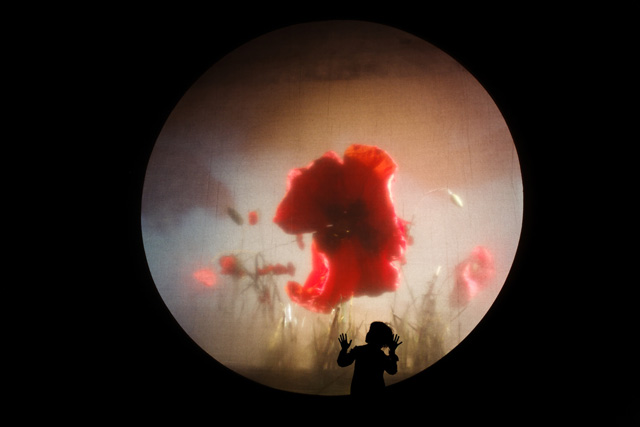
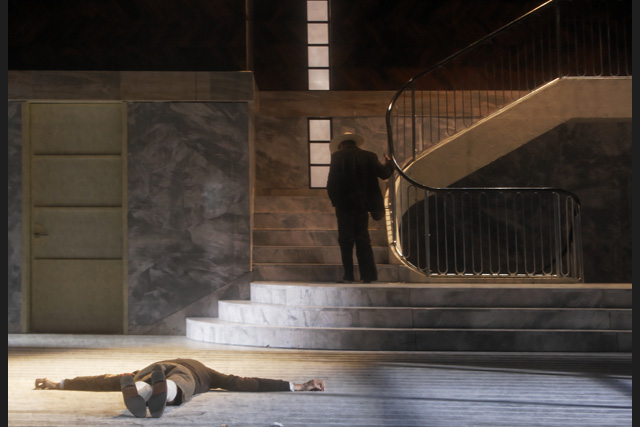
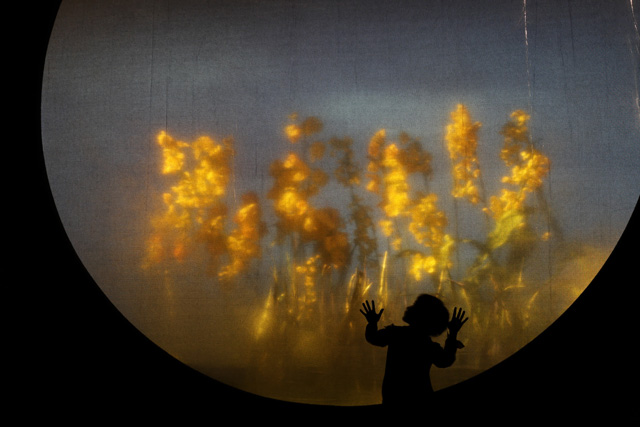
The man who goes through purgatory – the “song of the earth” – is a curious being, constantly stopped by the concrete nature of the things and objects that surround him, in a depiction of his own life. This material occupies him, blocks his way, attaches him and often torments him. It bears witness to what exactly purgatory is to Romeo Castellucci: human life in its daily repetition, familiarity with everyday tasks, the trap of routine, the experience of the ordinary body, encounters with the finished world, known nature, the substances of life. He knows that he is condemned to wander there, among reality, represented both without distance, abstractly, and hyper-realistically, “a reality without a shadow” says the director, who has engaged himself in a major work on evolving forms. Punishment, here, is just living, experiencing the world. This Purgatorio is therefore more than a show because it is also the occasion, for the spectator, for an experience that Romeo Castellucci considers very valuable: finding oneself, suddenly, on the other side of stagecraft, behind the performance. As if each individual could attend the projected show of his own life, but a primitive one, sent back to the earliest times, those of origins and birth. This suddenly offered lucidity, like an experience of a return to vision within contemporary nature, a return to sensation in the midst of a modern city, isn't it even more terrible? It is an existential anguish that springs up from this show, as if sensations and the body were dissolving in matter.
mise en scène, scénographie, lumières et costumes: Romeo Castellucci
musique originale: Scott Gibbons
chorégraphie: Cindy Van Acker, Romeo Castellucci
collaboration et architecture de la scénographie: Giacomo Strada
images: ZAPRUDERfilmmakersgroup
sculptures en scène: Istvan Zimmermann, Giovanna Amoroso
automates: Giuseppe Contini
réalisation des costumes: Gabriella Battistini
avec: Irena Radmanovic, Juri Roverato, Davide Savorani, Sergio Scarlatella, Pier Paolo Zimmermann
production: Gilda Biasini, Benedetta Briglia, Cosetta Nicolini
production: de la Trilogie Socìetas Raffaello Sanzio, Festival d'Avignon, Le Maillon-Théâtre de Strasbourg, Théâtre Auditorium de Poitiers - Scène nationale, Opéra de Dijon, barbicanbite09 (Londres)dans le cadre: du Spill Festival 2009, de Singel (Anvers), Kunstenfestivaldesarts /La Monnaie (Bruxelles), Festival d'Athènes, UCLA Live (Los Angeles), Napoli Teatro Festival Italia, Emilia Romagna Teatro Fondazione (Modène), La Bâtie-Festival de Genève, Nam June Paik Art Center /Gyeonggi-do (Corée), Vilnius Capitale européenne de la Culture 09, “Sirenos”–Festival international de théâtre de Vilnius, Cankarjev dom (Ljubljana), F/T 09 –Tokyo International Arts Festival
avec le soutien: du ministère italien du Patrimoine et des Activités culturelles, de la Région Émilie-Romagne et de la Ville de Cesena avec l'aide du programme Culture (2007-2013) de l'Union européenne
remerciement à: Comune di Senigallia-
Assessorato alla Cultura / AMAT
navette au départ d'Avignon