
© La Compagnie des Indes

reading of texts of Sade
with ISABELLE HUPPERT
Paris
Cour d'honneur du Palais des papes
National Premiere
Running time 1h10
Prices : from €38 to €10
|
S 4 |
S 5 |
M 6 |
T 7 |
W 8 |
T 9 20h |
F 10 |
S 11 |
S 12 |
M 13 |
T 14 |
W 15 |
T 16 |
F 17 |
S 18 |
S 19 |
M 20 |
T 21 |
W 22 |
T 23 |
F 24 |
S 25 |
|
© La Compagnie des Indes
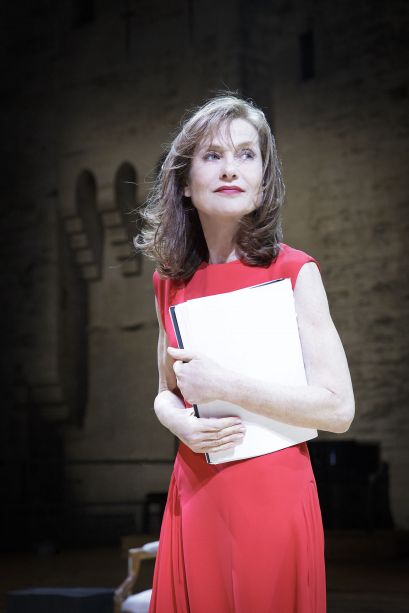
Juliette et Justine, le vice et la vertu © Christophe Raynaud de Lage
What if Justine and Juliette were the same person? What if the former's virtue and the latter's cynicism were but the two sides of a single soul? Such is the idea at the heart of this show by Raphaël Enthoven who, using Justine, or Good Conduct Well-Chastised and Juliette, or Vice Amply Rewarded, creates a dialogue between two worldviews that are also nothing more than two character traits. Those two figures needed one face that could give this argument between vice and virtue the sweeping scale of an inner dialogue: who better than Isabelle Huppert for such a performance? Alternating between the events and philosophical considerations of those at once picaresque and theoretical novels, intertwining accounts of awful orgies with fervent and vain prayers, this juxtaposition gives Isabelle Huppert the opportunity to embody at once the one who suffers and the one who is victorious, like the struggle of day against night. Justine is virtuous, believes in a God who has forsaken her, and her body remains unsullied no matter how much abuse is heaped upon it. Juliette is awful—or joyful maybe, believes only in her own pleasure, and notes that those who act like her are happy... Which one should we prefer to the other? Should we choose virtue, at the risk of suffering, over crime, even if it pays? Should we hate the heavens for being empty? And, most of all, is it better to suffer an injustice than to perpetrate it?
World-renowned for her work in cinema, the winner of two Best Actress awards at the Cannes Film Festival, Isabelle Huppert learned the ropes at the École de la Rue Blanche—now the ENSATT—then at the National Conservatory, notably with Antoine Vitez. Simultaneously with her work with the greatest film directors, Isabelle Huppert also works with the most challenging and prestigious theatre directors. She appears in Peter Zadek's adaptation of William Shakespeare's Measure for Measure in 1991. Robert Wilson has her speak Virginia Woolf's words in Orlando in 1993, then Heiner Müller's in Quartett in 2006. In 2000, Isabelle Huppert makes a grand entrance in Avignon with Euripides's Medea, directed by Jacques Lassalle in the Cour d'honneur of the Palais des papes, before appearing in Sarah Kane's 4.48 Psychosis, directed by Claude Régy in 2002. In 2005, she is in Henrik Ibsen's Hedda Gabler, directed by Éric Lacascade. She takes part in Krzysztof Warlikowski's adaptation of Tennessee Williams's A Streetcar Named Desire in 2010 at the Odéon-Théâtre de l'Europe, where she then works with Luc Bondy for his direction of Marivaux's Les Fausses Confidences.
Born in 1740, Donatien Alphonse François de Sade, better known as the Marquis de Sade, leads a life of debauchery that leads to a first series of trials and condemnations. While a prisoner at the Bastille, he writes his first works, including The 120 Days of Sodom. After his liberation, he divorces his wife and starts writing moral dramas, but in 1793, his Discours aux manes de Marat et de Le Pelletier (Eulogy for Marat and Le Pelletier) lands him in prison again. After this second stint in jail, he publishes Philosophy in the Bedroom in 1795, before being incarcerated one last time under Bonaparte as the author of Juliette, or Vice Amply Rewarded.
Texts chosen by Raphaël Enthoven
Light Bertrand Killy
With Isabelle Huppert
Production Les Visiteurs du Soir